The system that was built to protect the client and ended up trapping the professional
In 1913, a Boston lawyer invented the billable hour to protect the client. Today it traps the professional who got faster. The data on how outcome-based pricing is moving.
In 1913, a lawyer fresh out of Harvard took the job nobody in Boston wanted: running the legal aid office for people who couldn't afford a lawyer. His name was Reginald Heber Smith. He had close to 2,000 cases a year, a budget that didn't stretch, and a handful of assistants. To keep the office from collapsing, he needed to know exactly where everyone's time was going.
His solution was a timesheet divided into six-minute blocks: one tenth of an hour. Years later, Smith explained why he picked that number, and the reason was not scientific: "my only contribution was to decide that the minimum time entry should be one-tenth of an hour, because I can more easily add, subtract, and divide on the decimal system."
That is how the billable hour was born. It was not built to squeeze clients. It was built so a free legal aid office could serve more people with less money.
And it worked. With the tracking system Smith designed alongside a Harvard accounting professor, the office cleared 65% more cases in two years and the cost per case dropped from USD 3.93 to USD 1.63. Smith went on to run Hale and Dorr, one of Boston's big firms, for almost 40 years. His six-minute timesheet went with him.
📍 The full Heber Smith story, told by the firm he ran
From internal tool to industry standard
The jump took half a century and two pushes.
The first came in 1958. The American Bar Association published a pamphlet with a title that aged badly: "The 1958 Lawyer and His 1938 Dollar." The concern was that lawyers were earning less and less compared to doctors and dentists. The recommendation: track your time, bill it, and log at least 1,300 hours a year. The hour stopped being an internal control tool and became the unit of billing.
The second push came in 1975, when the United States Supreme Court struck down the minimum fee schedules set by state bar associations, ruling them price fixing. With no reference fees left, the hour became the only yardstick available. By the late seventies it was the standard, and from there it spread to the rest of professional services: accountants, consultants, a good share of architects and doctors in private practice.
A system built to protect the client from a number pulled out of thin air ended up being how almost every knowledge professional prices their work.
The flaw nobody designed
The flaw was always there, but for a century it didn't matter: the system pays for time, not results.
That worked when everyone took roughly the same amount of time. If drafting a distribution agreement took between 8 and 12 hours at any firm, billing by the hour was a reasonable way to measure the work. The difference between a good professional and a bad one was a difference of degree, not of kind.
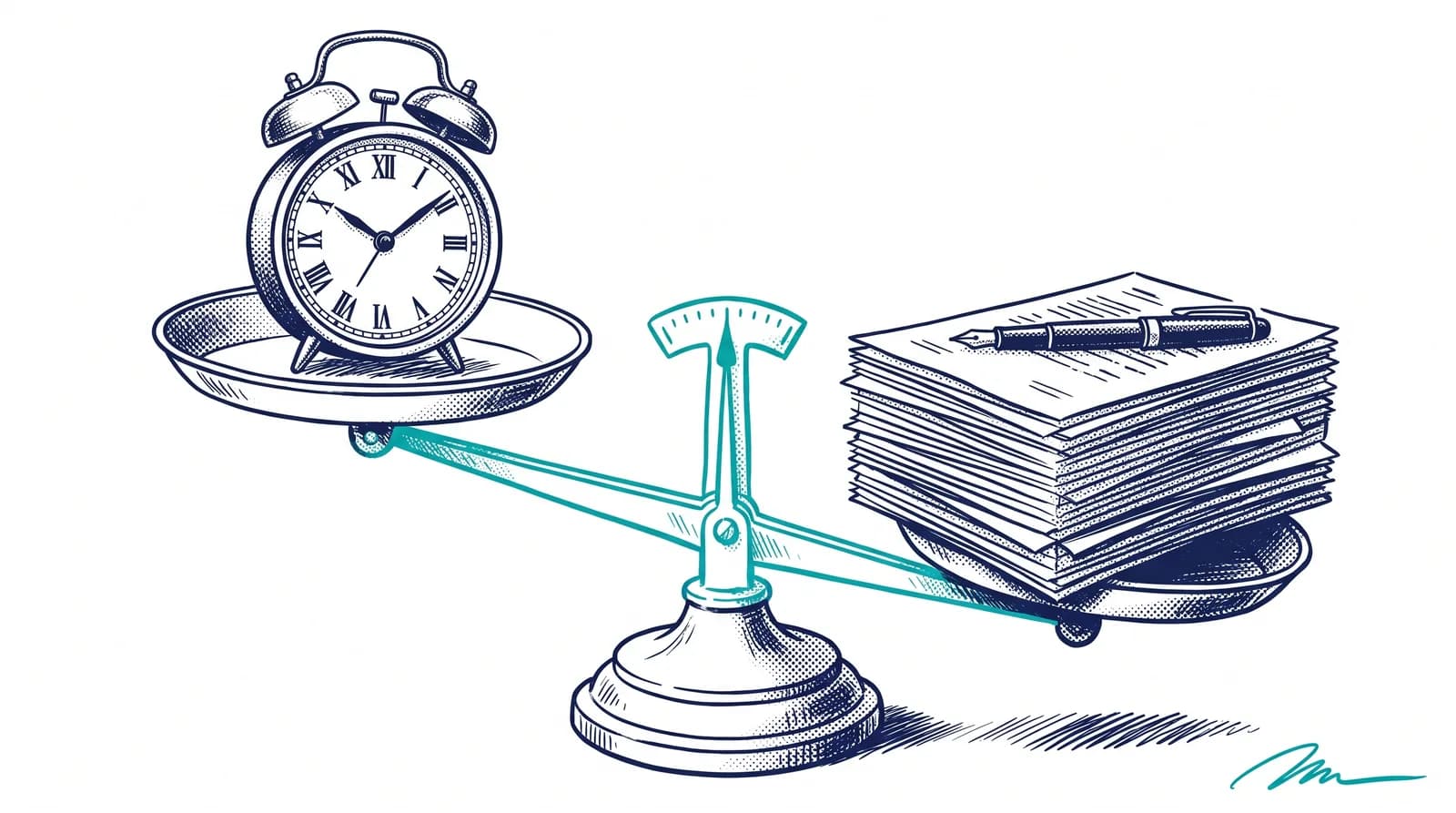
AI broke that symmetry. The report that took 10 hours can now come out in one. The research that filled an afternoon comes out in minutes. And that is where the system turns into a trap for the professional: if you bill by the hour and you get faster, you earn less. Your efficiency works against you.
Richard Susskind, the Oxford professor who has spent decades studying the future of the professions, wrote it before ChatGPT existed: hourly billing rewards the inefficient practice that stretches every matter, and punishes the one with systems built to resolve things fast. What used to be an academic observation became arithmetic anyone can do on a napkin.
What the firms with the most expensive hours are doing
McKinsey bills some of the most expensive hours in the world. That is why it matters what Michael Birshan, its UK managing partner, said in November 2025: close to 25% of the firm's global fees are now tied to outcomes, not time. This is not one team's experiment. It is a quarter of the revenue of the world's largest consulting firm.
Bain projects that its technology and AI work will go from 30% to 50% of its revenue. BCG expects its share to go from around 20% to around 40% in 2026. These two are targets declared by their executives, not accomplished facts: I read them as direction, not arrival. But the direction is the same across the three firms that define how consulting is sold worldwide.
📍 How McKinsey, BCG and Bain are moving their billing model
There is one more signal of where this points. In March 2026, Jeff Bleich, Anthropic's chief legal officer (the company behind Claude) and previously a partner at Dentons, one of the largest law firms in the world, said it in front of the American Bar Association: "I don't think the billable hour is the solution, and we've known it for a long time." He added that there is now a technology that will eliminate exactly the kind of tedious work people used to get rich on.
The company that builds the tool and the people who use it are saying the same thing.
📍 The full statement from Anthropic's chief legal officer on the billable hour
And it is not just the giants
A survey of 4,852 U.S. law firms, which together employ more than 164,000 lawyers, found that 72% already offer alternatives to hourly billing: flat fees, per-matter pricing, a fixed component plus an outcome component. Among firms with more than 150 lawyers, 96%. Hybrid arrangements grew 20% in a single year.
📍 The full survey of 4,852 firms on alternative fee arrangements
The same thing is happening at the other end of the table. Clio's legal trends report, which measures small and independent practices, found that 80% of lawyers who work solo already use flat fees for entire matters. It makes sense: for the independent professional, the flat fee is not a concession to the client. It is the only way to keep the efficiency you gain.
The uncomfortable part
With all that data, it would be easy to write that the billable hour is dying. It is not true. Three data points against:
Rates keep going up. Thomson Reuters' rates report recorded a 7.4% increase in 2025, more than double that year's inflation, the fastest growth they have on record. Partners at large U.S. firms have crossed USD 1,000 per hour.
Offering alternative pricing is not the same as using it. Alternative arrangements are applied to less than 40% of matters. Most of the world's professional work is still billed by time.
Most firms have not felt the hit yet. In the same survey of 4,852 firms, 58% say AI has had no impact on their billing. Only 19% report fewer billable hours. The change is visible in the direction, not yet in the volume.
📍 Thomson Reuters' 2026 rates report
What changed is not that the hour is dying. It is that it stopped being the option nobody had to justify. For a century, billing by time was the default answer and nobody asked questions. Now the question "why are you charging me by the hour?" needs an answer. And "because that's how it's always been done" is not one.
Three moves for this week
Measure first. Take the last piece of work you delivered and calculate how many hours it took you versus how many it would have taken you two years ago. Without that number, everything else is opinion.
Convert one single service to a flat fee. Not everything you do: one. The most repetitive one, where you already know exactly what it costs you to produce. It is the lowest-risk experiment, and it teaches you to price the result instead of the time.
If you can't leave the hour yet, raise it. If your hour produces twice what it did two years ago, the old rate pays you half. That is exactly what the big firms are doing: raising the rate while they migrate the rest of their billing to outcomes.
The napkin math
Heber Smith invented the billable hour so the client would not pay numbers pulled out of thin air. More than a century later, the question his system can no longer answer is a different one: when the 10-hour job comes out in one, what exactly are you charging for?
Do the math this week. Your last deliverable: the hours it took you against the hours it would have taken you two years ago. The difference between those two numbers is money, and that money already has an owner: either your pricing captures it, or it walks away without anyone having asked you for it.
Every Tuesday I break down a real operating decision, with the full reasoning. Read it if you run your own practice. Subscribe to Exoesqueleto Cerebral.