Why your AI gets worse the more you use it
A teacher found out why his AI got worse grading exam after exam in the same chat. It wasn't the prompt. It was the order he worked in.
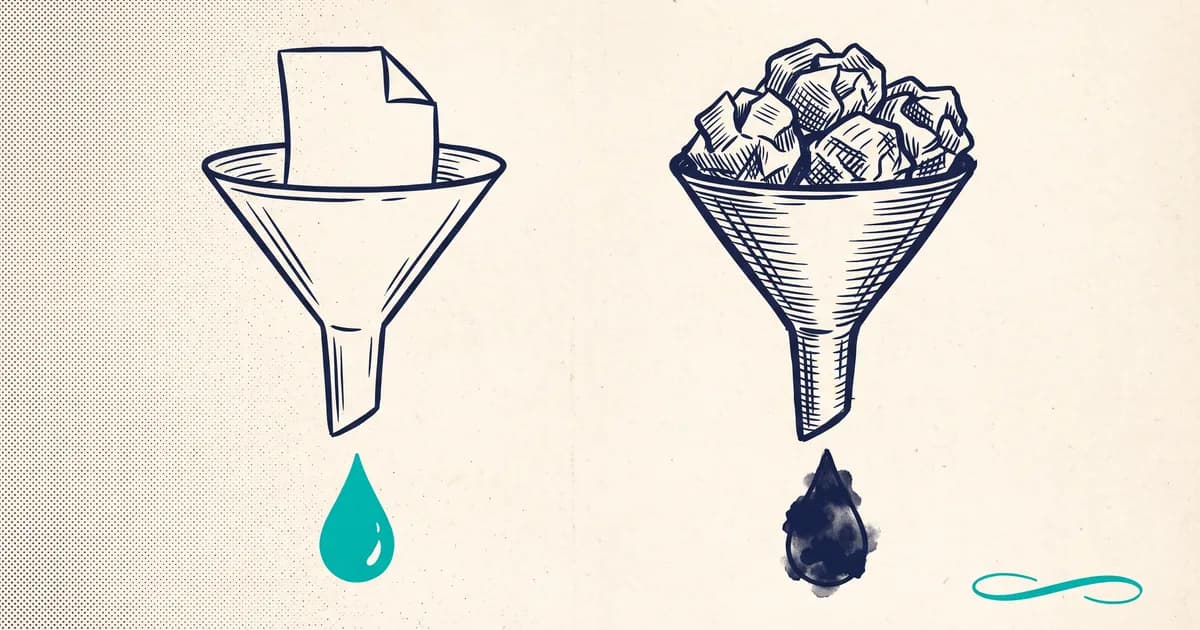
Maybe this has happened to you: you start using ChatGPT for a repetitive task, the first answers are good, and around the tenth one something goes sideways. The replies lose their edge. The question almost nobody asks is why your AI gets worse right when you're leaning on it the most. The short answer: the tool isn't wearing out. It's the order in which you use it.
David Roca is an English teacher in Spain, and he writes about getting AI into the classroom without the classroom feeling strange. He had to grade "writings", B1-level essays, a stack of them. His method was the most obvious one in the world: he opened a ChatGPT chat and pasted one exam, then another, then another, all in the same conversation.
The day it felt like the AI "got tired"
At first the feedback was sharp. Then it started to slacken. Comments across students looked too similar, as if everyone had made the same mistake. Criteria from earlier corrections leaked through. The first exam and the last one were no longer graded the same way. Roca describes it with a line anyone would get: it felt like "the AI got tired".
It didn't get tired. Machines don't get tired. What happened is simpler and more uncomfortable: the chat had filled up with junk. Every exam he pasted was still there, present, shaping how the AI read the next one. Roca gave it a name: context rot. The conversation window gets dirtier with everything that came before, and that noise starts to outweigh your actual instruction.
Why your AI gets worse even with a perfect prompt
Here's the twist almost nobody sees. You can have the best-written prompt on the planet. Drop it into a contaminated conversation and it doesn't matter.
Roca makes a distinction worth its weight in gold. A consistent correction applies the same criteria to all 30 exams. A contaminated correction lets the previous student's answer change how the next one gets read. From the outside they look alike. On the inside, one is fair and the other is a game of telephone where exam number 18 drags echoes of 3, 7 and 11.
People try to fix this by rewriting the prompt. They add sentences, polish it, beg the machine to be consistent. And the problem was never in the prompt. It was in the flow.
The fix wasn't a better prompt, it was changing the order
Roca didn't go hunting for magic words. He changed the mechanics. He separated two things that were getting tangled: what never changes and what changes with each case.
The permanent criteria (the rubric, the B1 level, what gets evaluated) went into a stable space: a "Project" in ChatGPT or Claude, a "Gem" in Gemini. That lives there, fixed, and never gets dirty. Then, for each student, he opens a clean chat, pastes only that text, reviews the proposed correction before handing it back, and closes that chat. Next student, new chat. His motto fits in one line: "Same rubric, same criteria, clean context."
The result isn't that he grades slower and more carefully. It's the opposite. As he puts it, the goal is to give better feedback and give it faster. The rubric stops being retyped by hand, every exam comes in untouched, and quality stops depending on how many you've already graded. You can read David Roca's original step-by-step guide for the full walkthrough.
This isn't about teachers
Swap "exam" for whatever you do. Reviewing 20 résumés for one opening. Reading 30 similar contracts. Clearing the day's support tickets. Reconciling the month's invoices. If you pile them into a single conversation, quality drops without warning and you catch it late, once you've already shipped résumé number 19 with the bias from number 4 stuck on top.
The pattern is always the same. The fixed part goes to a fixed place. The variable part comes into a clean space, gets reviewed, gets closed. It's the same logic as anyone who stops improvising and builds a way of working that holds up under volume, like the architect who built the system for his own studio. And it's also why the work of filtering and reviewing doesn't vanish with AI, it just changes shape, the way the junior rung changes shape rather than disappearing.
What you can do today
Before your next batch of repetitive AI tasks, stop for 30 seconds and separate. Ask yourself what stays the same across every case: that goes into a Project or a Gem, written once. And what changes case by case: that goes into a fresh chat, on its own, and gets closed when you're done.
You don't need a new tool or a 400-word prompt. You need to stop mixing. A dirty chat hands you dirty work, and the worst part is you don't even notice until you sit down and review it calmly.
Every Tuesday I break down a real operating decision, with the full reasoning. Read it if you run your own practice. Subscribe to Exoesqueleto Cerebral.