Access to frontier AI now runs through a permit
The US let Mythos 5 partly return and capped GPT-5.6. Access to frontier AI no longer depends on paying, but on a permit.
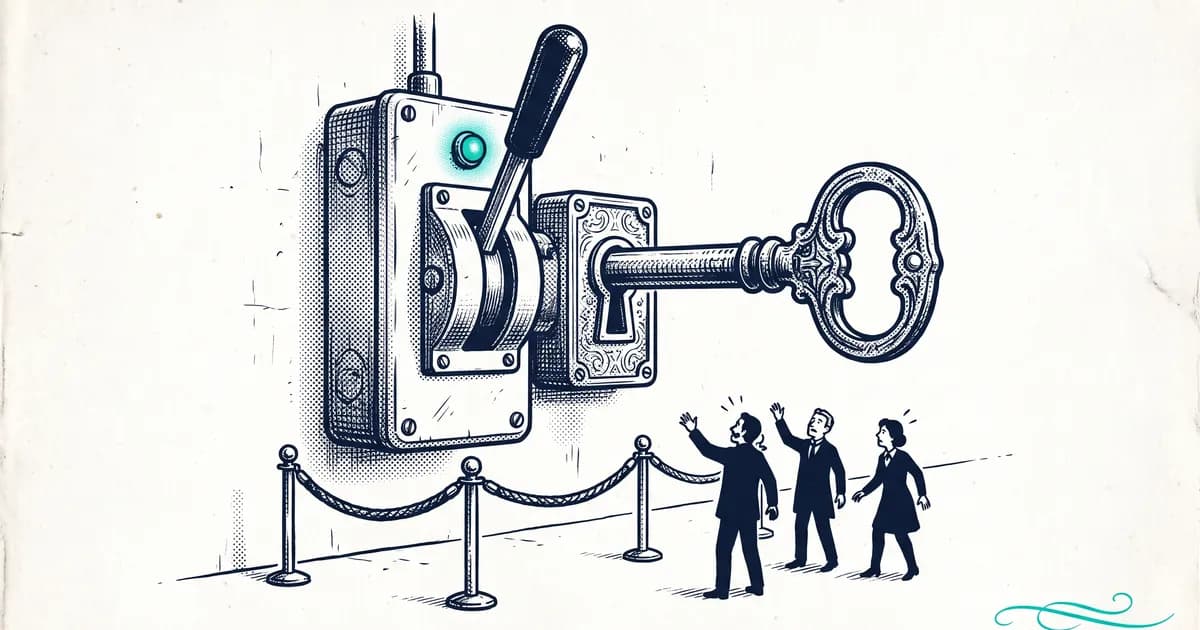
Access to the most capable AI stopped depending on your credit card. Friday, June 26, 2026 made it clear: the US Secretary of Commerce, Howard Lutnick, cleared a little over 100 organizations (government agencies and companies that run critical infrastructure) to start using Mythos 5 again, Anthropic's cybersecurity model. He said so in a letter. The rest of the world found out through the press. Until recently, the question was how much you paid. Now the question is different: did they give you a permit?
The day access to frontier AI became a permit
Mythos 5 had been switched off for two weeks. The accounts of why it was suspended differ depending on the source, and I'm not going to pretend I have the exact answer. What you can observe is the fact: a government controlled who could turn it back on. And it picked a small group.
That same Friday, OpenAI introduced its new GPT-5.6 family (with versions called Sol, Terra, and Luna). The Trump administration asked it to limit access to a set of trusted partners approved by the government, given how advanced the capabilities are. Two different companies, the same pattern on the same day: the most capable stuff gets handed out by list, not by subscription.
What got left out was what you use every day
Here's the detail that worries me most. Fable 5, Anthropic's general model (the one for everyday work: drafting, analyzing, summarizing, coding), did not make it into that clearance. Mythos came back, partly. Fable is still off, with no date.
If your workflow depends on a single top-tier model, this hits close to home. Not because you're a federal agency. Because you just watched, in real time, a tool you depend on get switched off by a decision you didn't make, and come back only for a chosen few. I already wrote about why Fable 5 is still suspended and what to do if you depended on it, because the practical question isn't when it returns, but what you do in the meantime.
Who controls the switch
When access depends on a permit, someone else holds the switch. It can be a government, like this week. It can be a price change. It can be a country deciding your region doesn't qualify. The cause changes. The consequence for you is the same: you lose the tool overnight.
It's worth reading the whole story. The US government authorizes the partial return of Mythos 5 for just over 100 approved organizations. Partial. Approved. Those two words are the point.
The mistake of betting everything on one model
A lot of people build their work around "the best model of the moment." I get it: today it's one, in three months it's another, and switching favorites feels like the smart move. But that race has a problem. If your whole system assumes that model will stay on, the day they switch it off, everything you built on top of it falls.
Guessing the top model is a game you don't control. What you do control is the way you work: how you organize your instructions, where you keep your context, which steps you take and which ones you hand to the machine. That stays with you even when the tool underneath changes. And, on top of that, it usually performs better: piling everything onto one giant model isn't the answer either, as I explained in why your AI performs worse the more you pile onto it.
What a system that doesn't fall over looks like
A system that holds up doesn't ask "which model do I use?" first. It asks "what do I want to happen?" Then it plugs in whatever model is available.
In practice that means concrete things. Keeping your instructions written down separately, not inside a single platform. Knowing two or three models that can do the task, not one. Storing your own context (your documents, your examples, your criteria) somewhere that's yours. Trying, every now and then, to do the same work with a different tool, so you don't discover you can't on the day you're forced to.
It's not paranoia. It's the difference between them changing your tool and them changing your work.
This week it happened to 100 organizations with resources to spare. They weren't the ones holding the switch. The question worth asking today, calmly, is simple: if they switch off your model tomorrow, how much of your work is still standing?
Every Tuesday I break down a real operating decision, with the full reasoning. Read it if you run your own practice. Subscribe to Exoesqueleto Cerebral.